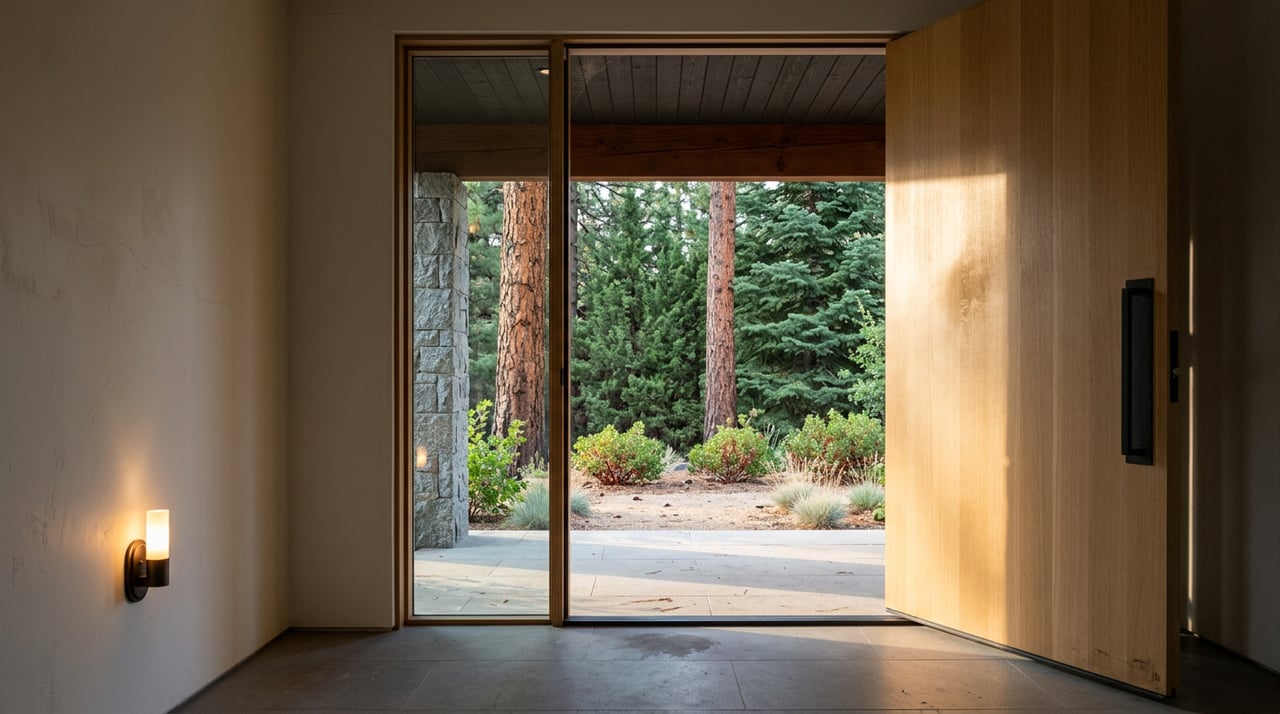
The Crystal Bay Closing Detail That Runs On A Seasonal Clock
July 23, 2026
July 23, 2026
The portal shows a price, a square-foot number, and a photo of the lake through the pines. What it does not show is whether the parcel carries a current TRPA Best Management Practices certificate, and in Crystal Bay that single line item on the tahoebmp.org Parcel Tracker can move an offer by tens of thousands of dollars.
Here is the thesis worth holding in front of you while the rest of this reads. The BMP certificate is not a point-of-sale requirement in the Tahoe Basin. It functions like one anyway, because the work window is seasonal and the calendar almost never fits inside an escrow. That gap between the written rule and the operating reality is where a Crystal Bay offer actually gets shaped.
TRPA proposed making BMP completion a point-of-sale requirement in 2014. A working group formed, the real estate community pushed back, and the final compromise landed on disclosure instead of completion. What survived is the requirement, under Chapter 60.4 of the TRPA Code of Ordinances, that every developed parcel in the Basin install and maintain stormwater BMPs, plus a real estate disclosure form the seller signs and submits to TRPA within 30 days of sale.
The compliance deadline for the installation itself expired October 15, 2008. Anything closing in Crystal Bay in 2026 is closing on a parcel that has been legally required to have BMPs in place for eighteen years. Enforcement, though, is complaint-driven and staged. The $5,000-per-day figure that appears on the disclosure form is a ceiling, not a routine outcome.
Pursuant to Chapter 60.4, all property owners within the Lake Tahoe Region are required to implement and maintain stormwater BMPs and obtain a BMP Certificate. Certificates are only valid and transferable as long as BMPs are maintained and remain effective.
Read that second sentence twice. A certificate on file from 2011 is not the same asset as a certificate issued last September. Aging certificates can require proof of maintenance to stay valid, and site conditions in the Basin change fast enough that a fifteen-year-old install may not pass a current inspection.
The physical work is seasonal. Grading, paving, and infiltration installations require unfrozen ground and a snow-free surface for the TRPA site verification that closes out the file. In practice the window opens somewhere between late April and early May and closes with the first sustained freeze, usually mid-October. Roughly 20 to 22 weeks of workable time in a normal year.
Inside that window the timeline from first call to certificate on file typically runs three to four months. Design and permit review can move in a couple of weeks with an experienced installer, but scheduling the inspection, hitting a weather window, and getting TRPA to sign off add lag. A standard Crystal Bay escrow with financing is closer to 35 to 45 days.
Do the arithmetic. If a Crystal Bay home goes under contract in October, the work cannot start until May, the certificate will not issue until August at the earliest, and the buyer is being asked to close in November. The ordinance says compliance is required. The calendar says it will not be done by closing. The offer is the instrument that reconciles the two.
A meaningful share of Crystal Bay parcels sit on shallow granite bedrock, near seasonal high groundwater, or on slow-infiltrating decomposed granite soils. TRPA classifies these as site-constrained. On a site-constrained parcel the stormwater cannot be infiltrated the standard way, and the property is eligible only for a Source Control Certificate rather than the full BMP Certificate.
For a buyer this matters twice. First, a Source Control Certificate is a legitimate compliance outcome, not a failure. Second, it can carry a future obligation to pay into an in-lieu fee or participate in a neighborhood project when the region moves to full compliance. If the tahoebmp.org search returns a yellow star instead of a green one, that is what you are looking at, and it belongs in the offer discussion.
The near-shore parcels most likely to be site-constrained are also the ones where shared access, private lanes, and clustered easements are common. The TRPA disclosure form is explicit that deed holders of properties with shared use areas, including HOA common areas and easements, may be collectively responsible for BMPs in those shared zones. On a private-lane lakefront cluster in Crystal Bay, the individual parcel can be compliant while the shared drainage is not, and enforcement can still reach the owner.
The most common seller mistake in Crystal Bay is treating the disclosure form as a formality. It is signed under penalty of perjury. Marking a certificate current when the maintenance has lapsed, or unknown when the tahoebmp.org record clearly shows a lapsed status, creates exposure that outlives the closing.
The second mistake is scheduling the certificate work during escrow to satisfy a buyer request. In a normal year, in a normal escrow, that timeline does not work. The seller who agrees to complete BMPs by closing in September on an August contract is agreeing to a promise the calendar will not let them keep. The cleaner move is a documented cost estimate from an approved installer, a matched credit at closing, and a clean disclosure that states the actual status.
Crystal Bay is the tightest small market on the Nevada north shore. In February 2026 the combined Incline Village and Crystal Bay market recorded 22 sales at a $2.07M median with a 95.4% sale-to-list ratio, and single-family homes closed at a $4.1M median in 61 days. In a market that thin and that quick, the BMP conversation is not a footnote. It is one of the three or four items that determine whether a deal closes on the price both sides shook on or drifts sideways in the last week.
Can I require the seller to complete BMPs as a condition of closing?
You can request it, and outside the seasonal work window you will not get it. A credit sized to a written installer bid is the outcome most Crystal Bay transactions land on when the certificate is missing or lapsed and the ground is frozen.
Does the MLS listing tell me whether a parcel has a current BMP certificate?
No. The regional MLS does not carry BMP status as a searchable field, so verification runs through the TRPA Parcel Tracker or the BMP Helpline. A listing that mentions the certificate is offering a claim you should still confirm by APN.
Is a Source Control Certificate a problem?
Not on its own. It reflects a legitimate compliance path for site-constrained parcels. What you want to understand before closing is the future obligation attached to it, including any in-lieu fee or neighborhood-project participation the region may require as the compliance program evolves.
Who is responsible for BMPs on a shared driveway or private lane?
The TRPA disclosure language treats deed holders of shared use areas as potentially collectively responsible. On the private-lane clusters common near the Crystal Bay shoreline, that means the road maintenance or HOA agreement is part of the diligence, not a separate topic.
If you are writing an offer on a Crystal Bay home this season, or listing one and want the certificate conversation resolved before it becomes a price conversation, the value is in the sequencing. Get the APN, pull the record, size the number, and let the offer reflect what the calendar actually allows. That is the work Jena Lanini does with clients on both sides of the Nevada north shore, and it is where a boutique, local read on the transaction earns its keep. Discover elevated living — start your search.
Stay up to date on the latest real estate trends.





Jena Lanini crafts refined real estate experiences with strategy, heart, and unmatched local insight. From Reno to Lake Tahoe, trust her to navigate your next move with clarity and confidence.